Download
Abstract
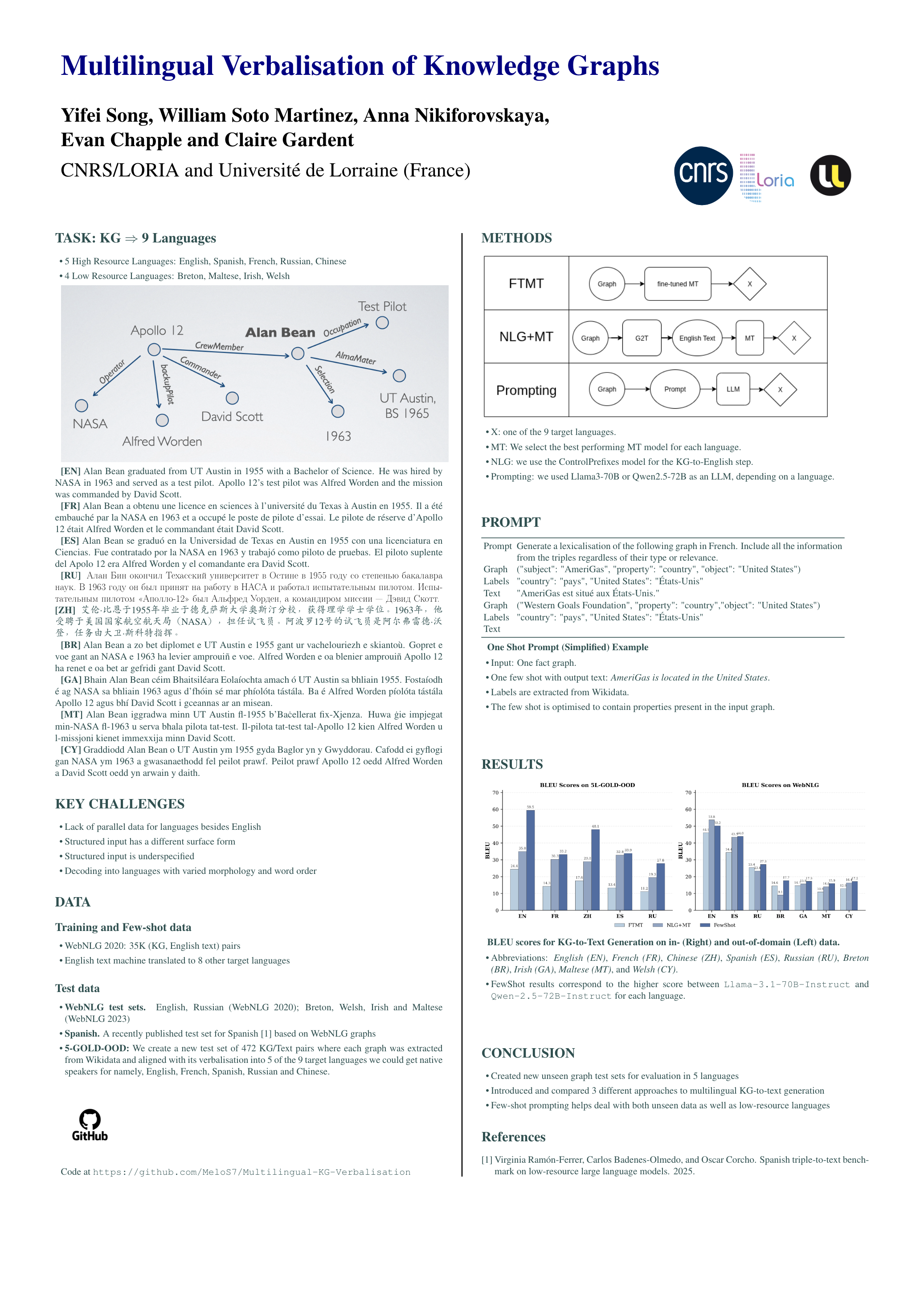
Most work on Knowledge Graph (KG) verbalisation is monolingual leaving open the question of how to scale KG-to-Text generation to languages with varying amounts of resources. In this work, we explore KG-to-Text generation on nine languages including five high-resource (HR) languages (English, Chinese, French, Spanish, Russian) and four low-resource (LR) languages (Breton, Irish, Maltese, Welsh). We first construct silver multilingual training data for all nine languages and new gold out-of-domain test data for the five HR languages. Using this data and already available in-domain test sets for 7 of our 9 languages, we then compare three strategies: (1) NLG+MT—a state-of-the-art KG-to-English model followed by Machine Translation (MT) into the target language; (2) FTMT—multilingual MT models fine-tuned end-to-end on the silver data; and (3) FewShot—few-shot LLM prompting comparing 4 LLMs. We explore different prompting strategies and show that our best prompting strategy performs the best on all 9 languages, discussing the relative performance of the three approaches on Low vs High Resource languages and on in- vs out-of-domain data.
Poster
Citation
@inproceedings{song-etal-2025-multilingual-verbalisation,
    title = "Multilingual Verbalisation of Knowledge Graphs",
    author = "Song, Yifei  and
      Martinez, William Soto  and
      Nikiforovskaya, Anna  and
      Chapple, Evan Parker Kelly  and
      Gardent, Claire",
    editor = "Christodoulopoulos, Christos  and
      Chakraborty, Tanmoy  and
      Rose, Carolyn  and
      Peng, Violet",
    booktitle = "Findings of the Association for Computational Linguistics: EMNLP 2025",
    month = nov,
    year = "2025",
    address = "Suzhou, China",
    publisher = "Association for Computational Linguistics",
    url = "https://aclanthology.org/2025.findings-emnlp.60/",
    doi = "10.18653/v1/2025.findings-emnlp.60",
    pages = "1111--1162",
    ISBN = "979-8-89176-335-7",
    abstract = "Most work on Knowledge Graph (KG) verbalisation is monolingual leaving open the question of how to scale KG-to-Text generation to languages with varying amounts of resources. In this work, we explore KG-to-Text generation on nine languages including five high-resource (HR) languages (English, Chinese, French, Spanish, Russian) and four low-resource (LR) languages (Breton, Irish, Maltese, Welsh). We first construct silver multilingual training data for all nine languages and new gold out-of-domain test data for the five HR languages. Using this data and already available in-domain test sets for 7 of our 9 languages, we then compare three strategies: (1) NLG+MT{---}a state-of-the-art KG-to-English model followed by Machine Translation (MT) into the target language; (2) FTMT{---}multilingual MT models fine-tuned end-to-end on the silver data; and (3) FewShot{---}few-shot LLM prompting comparing 4 LLMs. We explore different prompting strategies and show that our best prompting strategy performs the best on all 9 languages, discussing the relative performance of the three approaches on Low vs High Resource languages and on in- vs out-of-domain data.The models, the test set, and the silver training data are available at https://github.com/MeloS7/Multilingual-KG-Verbalisation."
}